
Project Overview
This mechanical design study explores the development of a shell-and-tube heat exchanger assembly, with attention to component arrangement, interfaces, manufacturability and the practical requirements of a complete mechanical system.
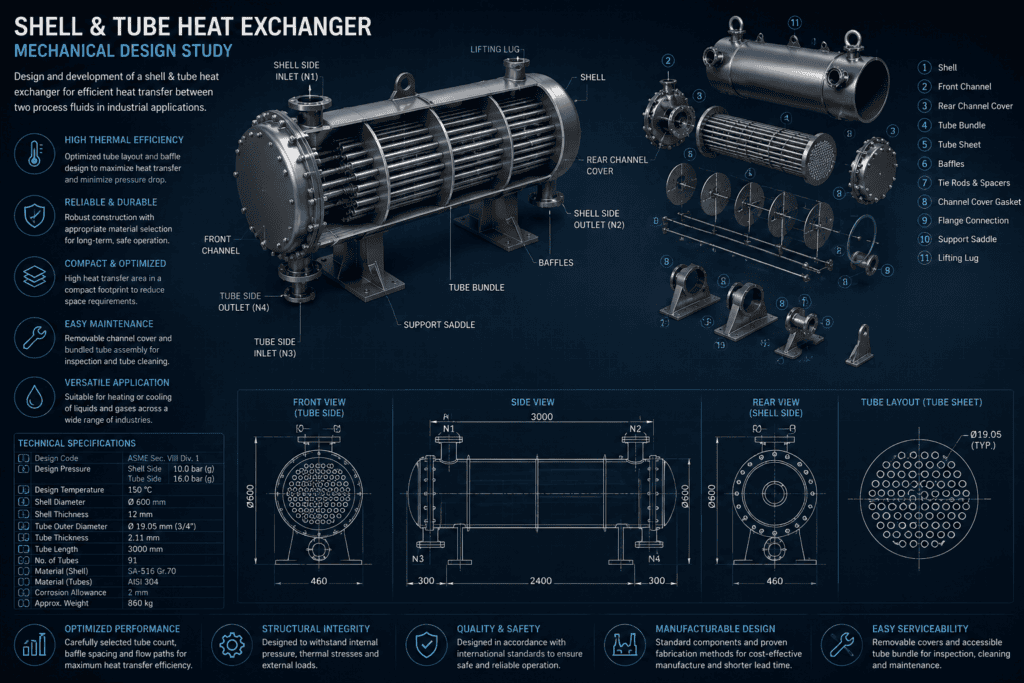
Design Requirements
The study considers the principal requirements that influence the mechanical arrangement of the heat exchanger, including the tube bundle, shell, end closures, fluid connections, internal support features, assembly requirements and access for manufacture and maintenance.
Mechanical Design Development
The assembly is developed as an integrated mechanical system rather than a collection of individual components. Particular attention is given to the relationship between the shell, tube bundle, tube sheets, end closures, supports and fluid connections, while considering assembly sequence, component accessibility and the practical manufacture of the principal parts.
Engineering Considerations
Design decisions are considered in relation to material selection, wall thicknesses, interfaces, fastening and sealing arrangements, support of the tube bundle, thermal effects and the loads transferred through the assembly. These considerations help identify areas that may require further calculation, detailed analysis or refinement as the design progresses.
Outcome & Next Steps
The resulting concept provides a structured basis for further engineering development. Subsequent work could include detailed thermal and fluid-flow assessment, pressure-drop evaluation, structural verification of critical components, refinement of manufacturing details and preparation of production drawings as the design progresses toward a fully defined engineering solution.