
Project Overview
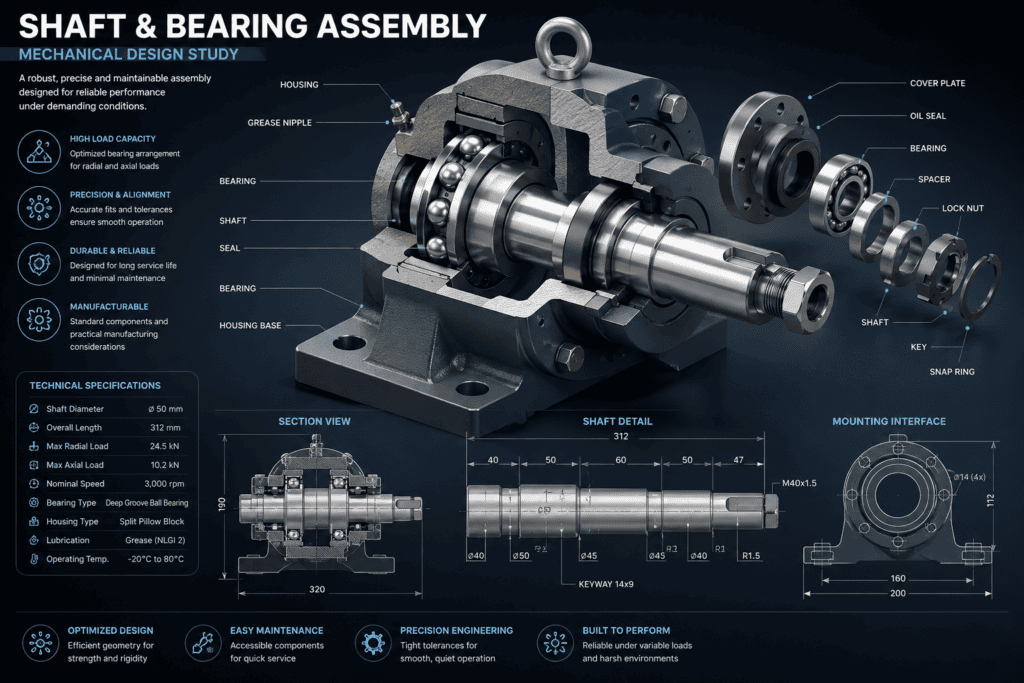
This mechanical design study explores the development of a shaft and bearing assembly used to support and transmit rotational motion within a mechanical system. The study considers the relationship between the shaft, bearings, housing, retaining features and associated interfaces, with emphasis on producing a practical assembly that can be manufactured, assembled and maintained effectively.
Design Requirements
The assembly is required to support a rotating shaft while maintaining accurate alignment and allowing smooth rotational movement under representative operating loads. The design must provide suitable locations for the bearings, control axial and radial positioning of the components and provide appropriate interfaces with the surrounding mechanical system.
Consideration is also given to accessibility, component replacement and the use of standard engineering components wherever practical.
Shaft Design
The shaft geometry is developed around the functional requirements of the assembly. Changes in diameter, shoulders, bearing seats, retaining features and component interfaces are incorporated to locate the individual parts and transfer loads effectively.
Particular attention is given to transitions between shaft diameters, since abrupt geometric changes can introduce local stress concentrations. Appropriate radii, shoulders and dimensional relationships are therefore considered during development of the shaft geometry.
Bearing Selection & Arrangement
The bearing arrangement provides radial support for the shaft while also controlling its axial position where required. Bearing type, size and positioning are considered in relation to expected loading, rotational speed, available installation space and the required service life of the assembly.
The arrangement must also account for practical installation and removal of the bearings, together with suitable fits between the bearing races, shaft and housing.
Housing & Component Integration
The bearing housing provides structural support and maintains the required alignment between the bearings and rotating shaft. Its geometry is developed around the bearing locations, mounting interfaces and surrounding assembly constraints.
The design considers wall thickness, bearing seats, fastening locations and access for assembly. Where appropriate, features may also be incorporated for lubrication, sealing and inspection.
Fits, Tolerances & Assembly
Correct fits and tolerances are important to the performance of a shaft and bearing system. Bearing seats must provide appropriate control of the inner and outer races while avoiding excessive interference or unwanted movement during operation.
The assembly sequence is also considered during the design process to ensure that bearings, spacers, retaining components and the shaft can be installed without unnecessary complexity. Dimensional tolerances would ultimately be defined according to the selected bearings, operating conditions and manufacturing processes.
Engineering Considerations
The performance of the assembly can be influenced by radial and axial loads, shaft deflection, bearing spacing, rotational speed, lubrication, temperature and manufacturing tolerances. These factors should be considered together rather than treating individual components independently.
Where operating loads are significant, additional engineering calculations or FEA may be used to assess shaft stresses, deflection, bearing reactions and the structural behaviour of the housing.
Manufacturability & Maintenance
The design is developed with practical manufacture and maintenance in mind. Shaft features should be compatible with appropriate machining processes, while the housing should provide sufficient access for bearing installation and removal.
The use of standard bearings, seals and retaining components can reduce manufacturing complexity and simplify future maintenance. Assembly access and the ability to replace wear components are therefore considered as part of the overall mechanical design.
Outcome & Next Steps
The resulting concept provides an integrated basis for the development of a practical rotating assembly in which the shaft, bearings, housing and retaining features function as a coordinated mechanical system.
Further development could include detailed shaft calculations, bearing-life assessment, tolerance and fit specification, seal selection, lubrication requirements, structural verification and preparation of manufacturing drawings and assembly documentation.